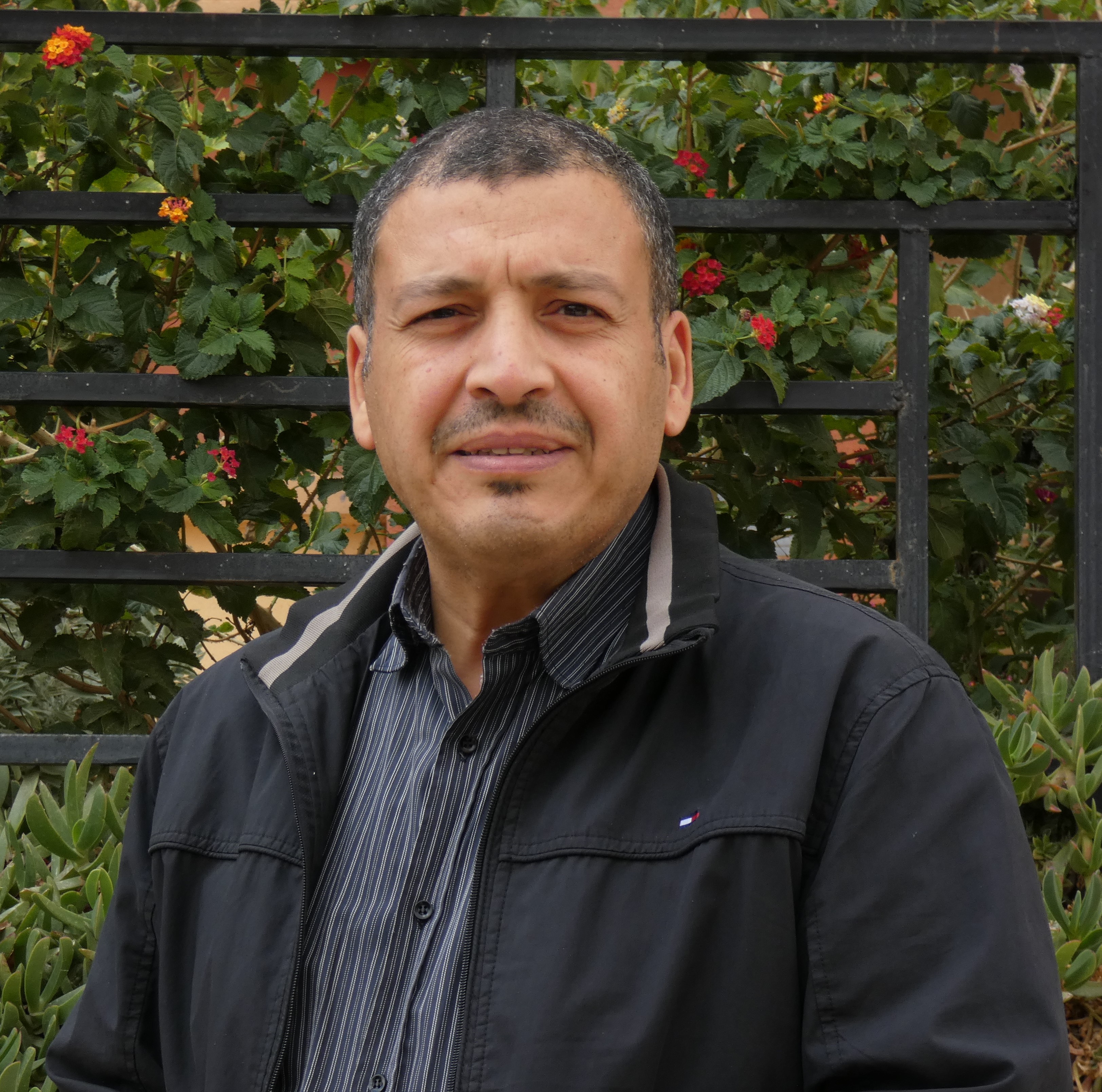
RADHOUANE Benmehaia
بن مهية رضوان
radhouane.benmehaia@univ-msila.dz
06 71 45 46 54
- Departement of Nature and life sciences
- Faculty of Sciences
- Grade MCA
About Me
Research Domains
Plant biology
LocationMsila, Msila
Msila, ALGERIA
Code RFIDE- 2025
-
Encaderement master
Chikh salsabil , Merzougui imane, Oulha nesrine
Caractérisation biométrique et viabilité du pollen chez le palmier dattier (Phoenix dactylifera L.)
- 2025
-
Encaderement master
DIF Asma , MARHOUNE Loubna
Évaluation des caractéristiques botaniques et reproductives de quelques variétés du quinoa (Chenopodium quinoa Willd )
- 2024
-
Encaderement master
BENAFOU ELHADJ YOUCEF , OKAT ZOUBAIDA INSSAF, HACHEMI RANA
Les effets anatomiques de cochenille blanche (Parlatoria blanchardi Trag) sur quelques variétés de palmier dattier
- 1976-12-09 00:00:00
-
RADHOUANE Benmehaia birthday
- 2025-05-03
-
2025-05-03
The first assessment of phenotypic diversity in four quinoa (Chenopodium quinoa Willd.) populations cultivated in Algeria based on morphological traits
In the present study, the morphological variation among seventeen accessions from four quinoa populations (Giza 01, Q101, Q102, and Black) cultivated in a semi-arid region of Algeria was investigated using 26 morphological descriptors established by the International Union for the Protection of New Varieties of Plants (UPOV), along with descriptors from FAO, PROINPA, INIAF, and FIDA. The study aimed to determine which of these descriptors serve as robust estimators of phenotypic diversity within quinoa populations accessions and to analyze the patterns of morphological diversity in cultivated quinoa in Algeria. To address these objectives, Principal Component Analysis (PCA), Hierarchical Cluster Analysis, and the Shannon–Weaver diversity index (H’) were employed. The selected 26 descriptors covered plant structural traits, leaf characteristics, inflorescence features, stem properties, panicle attributes, and seed traits to assess the overall degree of polymorphism among the studied accessions. The computed H’ index values ranged from 0.38 for plant height (PH) to a maximum of 0.98 for branching type (TB), leaf size, and foliage color (FC). The average diversity index among all traits and populations was 0.59, reflecting a substantial level of genetic diversity within the collection. The relative magnitude of the first two PCA eigenvectors indicated that 11 out of the 26 descriptors were the most significant for populations classification. Multivariate analyses, including factorial correspondence analysis and cluster analysis based on morphological descriptors, facilitated the classification of the quinoa accessions into three discrete groups. The first group consisted of four accessions (Giza 01), while the second group was subdivided into two subgroups: the first, a major subgroup comprising eight accessions (Q102), and the second, a minor subgroup with a single accession (Q101). The third group included four accessions (Black). The findings of this study represent a crucial step toward the efficient selection of promising quinoa accessions and their optimal management and conservation.
Citation
Radhouane BENMEHAIA , , (2025-05-03), The first assessment of phenotypic diversity in four quinoa (Chenopodium quinoa Willd.) populations cultivated in Algeria based on morphological traits, Ecological Engineering & Environmental Technology (EEET), Vol:26, Issue:6, pages:275–285, Polskie Towarzystwo Inzynierii Ekologicznej
- 2023-11-14
-
2023-11-14
Physiochemical analysis of pollen grain properties of various male varieties of date palm (Phoenix dactylefera L.) grown in Oued Righ Algeria
This study aimed to evaluate the physicochemical properties of pollen grains from several male date palm (Phoenix dactylifera L.) varieties cultivated in the Oued Righ region of southeastern Algeria. Pollen samples from the main local male genotypes were collected at anthesis and analyzed for moisture content, ash, pH, color parameters, and basic proximate composition (proteins, lipids, carbohydrates), as well as selected bioactive markers such as total phenolics and flavonoids using standard analytical protocols. The results revealed significant inter-varietal differences in pollen composition, with some males exhibiting higher protein and phenolic levels, while others showed greater carbohydrate content and lighter color indices, reflecting distinct nutritional and functional profiles. Correlation analysis indicated positive associations between proteins and phenolic compounds and a negative relationship between total sugars and antioxidant-related constituents, suggesting potential trade-offs in biochemical allocation among varieties. Overall, the findings highlight substantial intraspecific variability in pollen quality among Oued Righ male date palms
Citation
Radhouane BENMEHAIA , DERBALI safia, BENMEDDOUR Tarek, SIMOZRAG Ahmed, ZEROUAL Samir, ,(2023-11-14), Physiochemical analysis of pollen grain properties of various male varieties of date palm (Phoenix dactylefera L.) grown in Oued Righ Algeria,1st International sSeminar on Ecology & Biotechnology, Mediterranean Atmosphere Climate (ISEBMCE'23),Setif
- 2022-09-01
-
2022-09-01
Relation between storage temperature and phenolic compounds in date fruits (Phoenix dactylifera L.).
Abstract literature suggest that date palm cultivars are a promising source of beneficial compounds, of which many cultivars around the world are gaining increasing interest due to their important biological properties. Hence, there is a need to be further investigated in Algerian date palm cultivars. The purpose of this study was to identify the effect of the storage temperature variation on the content of phenolic compounds in dates for some Algerian cultivars (Deglet Nour, Ghars, Mech Degla, Degla Baidha). The fruits of the four cultivars were preserved in varying degrees of temperature (4 C and ambient temperature). To determine the effect of the varying degrees of storage temperature on the content of phenolic compounds, the total phenols, flavonoids and total tannins were measured. The differences were noted for the five studied parameters. We found that there was a storage temperature effect on the pH …
Citation
Radhouane BENMEHAIA , Ahmed Simozrag, Samir Zeroual, , (2022-09-01), Relation between storage temperature and phenolic compounds in date fruits (Phoenix dactylifera L.)., South Asian Journal of Experimental Biology, Vol:12, Issue:5, pages:708-715, SAJEB
- 2019-06-30
-
2019-06-30
Effet des différentes catégories d’âge de l’arbre dans le comportement de quelques variétés d’abricotier (Prunus Armeniaca L.) dans la région de Magra, M’Sila, Algérie.
L’abricotier c’est l’une des espèces fruitières la plus répondue en Algérie, la wilaya de M’Sila est l’une des plus importantes régions de l’Algérie qui recèle des variétés les plus appréciées. Notre expérimentation s’intéresse à plusieurs aspects concernant l’étude du comportement de trois variétés (Louzi rouge, Bulida et Pavit) d’abricotiers vis-à-vis de l’effet de la catégorie d’âge de l’arbre, pour chaque stade phénologique du cycle biologique annuel de l’abricotier et les caractéristiques physiques et biochimiques des fruits. La variété Bulida est la plus précoce, suivie par la variété Pavit et enfin par la variété Louzi rouge qui est la plus tardive. On note que l’influence de l’âge de l’arbre est très importante sur le pourcentage des stades phénologiques, du débourrement des boutons floraux à la maturation des fruits généralement la valeur la plus élevée est notée généralement chez les arbres adultes. Les bonnes caractéristiques physiques des fruits sont en faveur des arbres adultes tandis que les caractéristiques organoleptiques sont meilleures chez les fruits des vieux arbres.
Citation
Abdelghani ZEDAM , HAMDI Bendif , Radhouane BENMEHAIA , Slimane TELLACHE , Bahlouli Fayçal, Slamani Amel, , (2019-06-30), Effet des différentes catégories d’âge de l’arbre dans le comportement de quelques variétés d’abricotier (Prunus Armeniaca L.) dans la région de Magra, M’Sila, Algérie., Revue des bioressources, Vol:9, Issue:1, pages:18-26, Université Kasdi Merbah de Ouargla- Algérie
- 2019
-
2019
EFFET DES DIFFERENTES CATEGORIES D’AGE DE L’ARBRE DANS LE COMPORTEMENT DE QUELQUES VARIETES D’ABRICOTIER (Prunus armeniaca L.) DANS LA REGION DE MAGRA, M’SILA, ALGERIE
L’abricotier c’est l’une des espèces fruitières la plus répondue en Algérie, la wilaya de M’Sila est l’une des plus importantes régions de l’Algérie qui recèle des variétés les plus appréciées. Notre expérimentation s’intéresse à plusieurs aspects concernant l’étude du comportement de trois variétés (Louzi rouge, Bulida et Pavit) d’abricotiers vis-à-vis de l’effet de la catégorie d’âge de l’arbre, pour chaque stade phénologique du cycle biologique annuel de l’abricotier et les caractéristiques physiques et biochimiques des fruits. La variété Bulida est la plus précoce, suivie par la variété Pavit et enfin par la variété Louzi rouge qui est la plus tardive. On note que l’influence de l’âge de l’arbre est très importante sur le pourcentage des stades phénologiques, du débourrement des boutons floraux à la maturation des fruits généralement la valeur la plus élevée est notée généralement chez les arbres adultes. Les bonnes caractéristiques physiques des fruits sont en faveur des arbres adultes tandis que les caractéristiques organoleptiques sont meilleures chez les fruits des vieux arbres.
Citation
Abdelghani ZEDAM , Radhouane BENMEHAIA , Slimane TELLACHE , BAHLOULI Faycal, SLAMANI Amal, , (2019), EFFET DES DIFFERENTES CATEGORIES D’AGE DE L’ARBRE DANS LE COMPORTEMENT DE QUELQUES VARIETES D’ABRICOTIER (Prunus armeniaca L.) DANS LA REGION DE MAGRA, M’SILA, ALGERIE, Revue des BioRessources, Vol:9, Issue:1, pages:18-26, Université Kasdi Merbah Ouargla
- 2018-12-02
-
2018-12-02
Analyse de la densité de plantation des palmeraies dans la wilaya de biskra à travers des données exhaustives.
Notre étude d ‘analyser empiriquement l ‘une des dimensions fondamentales de la technologie de production phœnicicole: la densité de plantation des palmes. Notre étude est menue dans la région de Biskra. Nous avons utilisé une base de données exhaustive comprenant 21 503 producteurs de dattes distribués sur 33 communes, afin de révéler les régularités présentes dans notre région. L ‘analyse montre que la distribution de la densité de plantation est hétérogène par un spectrum très large. Après un traitement statistique par une analyse de variance suivi par un test de moindres différences significatives résultant un classement des communes, un zonage est procédé pour faire apparaitre le différentiel de densité sur la totalité de cette région. Ce différentiel pourrait être expliqué par deux facteurs spécifiques à la région: la présence des sources d ‘eau d ‘irrigation et les cultures adjacentes.
Citation
Radhouane BENMEHAIA , K Atallaoui, , (2018-12-02), Analyse de la densité de plantation des palmeraies dans la wilaya de biskra à travers des données exhaustives., Revue des BioRessources, Vol:8, Issue:2, pages:96-104, University of Ouargla
- 2018-03-21
-
2018-03-21
Socioeconomic analysis of date palm sector: The case of Biskra region (Algeria)
Regarding the importance of date palm sector for local development, this study aims to explore and analyze empirically the main socioeconomic characteristics of date palm sector in Biskra region. The study uses an extensive micro-database containing 21,502 date palm farms. The technico-economic aspect of date palm farm is reflected by two structural features: size and tree density; since the social aspect is reflected by human capital dimension measured by farmer’s age and his experience. Our study is mainly explorative and attempts to extract the empirical regularities which would be helpful for policy making.
Citation
Radhouane BENMEHAIA , Mohamed Amine BENMEHAIA, ,(2018-03-21), Socioeconomic analysis of date palm sector: The case of Biskra region (Algeria),Sixth International Date Palm Conference.,Abu Dhabi, United Arab Emirates
- 2017-12-29
-
2017-12-29
Contribution to the study of some aspects of pollination in six varieties of apricot in the region of M'sila (Algeria)
The present work consists in contributing to the study of pollination. Field observations and tests were carried out on six varieties of apricot in the region of M'sila, "Pavit", "Boulida" "Alarbi", "Tounsi", "Ben sarmouk" and "Louzi rouge". For natural self-pollination, the branches were covered to avoid cross-pollination, and the fruit set was determined. Controlled pollination was carried out using pollen and pollen from the other trees that bloom at about the same time. The fruit set rate was determined after counting the fruits in relation to the number of blooming flowers. The rate of fruit set varies from one variety to another. Alarbi with 62.5%, Louzi with 69.7%, Tounssi with 56.5%, Bulida with 50.7%, Ben Sermouk with 23.2%, and Pavit with 45.8%. The bagging rate of the bagged branch obtained at the end of the physiological fall did not show any significant differences between the varieties and ranged between 77.50% for Alarbi and 41.22% for Pavit. The results show that the number of fruits after manual crossing is zero for all crops. All varieties tested are self-compatible and no cross-compatibility group has been guessed on the tested growths, from self-pollination and inter-pollination.
Citation
Abdelghani ZEDAM , HAMDI Bendif , Radhouane BENMEHAIA , Slimane TELLACHE , BBQHLOULI Fayçal, Salamani Amel, , (2017-12-29), Contribution to the study of some aspects of pollination in six varieties of apricot in the region of M'sila (Algeria), Journal of Scientific Agriculture, Vol:1, Issue:, pages:347–351, Update Publishing House
- 2017-12-02
-
2017-12-02
Situation des palmeraies de M’sila: production et contraintes
La région de M’sila a une vocation éprouvée pour la phœniciculture, notamment dans le sud. Avec des surfaces cultivées étendues sur 50 km, les palmeraies sont installées et agencées pour constituer une zone phoenicicole par excellence. Ce travail porte sur l'étude de secteur de palmiers dattiers et la production des dattes dans la région de M’sila. Nous avons fait une enquête sur terrain qui touche les agriculteurs et les organisations administratives locales d’agriculture. L'étude statistique de toutes les palmeraies a montré plus de 7500 palmiers sur une superficie de 420 ha et avec une quantité de production des dattes plus de 2000 quintaux. De ce fait, cette zone présente un potentiel qui nécessite une meilleure exploitation.
Citation
Radhouane BENMEHAIA , K ATALLAOUI, A DJOUDI, , (2017-12-02), Situation des palmeraies de M’sila: production et contraintes, Revue des BioRessources, Vol:7, Issue:2, pages:65- 71, University of Ouargla
- 2017-10-29
-
2017-10-29
Caractère d'auto - et d'inter - compatibilité chez six cultivars d'abricotier dans la région de M'sila (Algérie)
L’abricotier constitue une culture stratégique dans la région du M’sila. Le présent travail consiste en la contribution { l’étude de la pollinisation, des observations sur terrain et des tests ont été menés sur six variétés, "Pavit","Boulida","Alarbi","Tounsi","Bensearmouk" et "Louzi rouge". Le taux de débourrement et de floraison, a été déterminé par comptage du nombre de boutons floraux ayant débourrés par rapport au nombre total de boutons floraux. Et du nombre de fleurs épanouies sur le nombre total de boutons à fleurs débourrés respectivement. Pour l’autopollinisation naturelle, les branches ont été ensachées pour éviter la pollinisation croisée, et l'ensemble de fruits a été déterminé. Des pollinisations contrôlées ont été réalisées en utilisant le propre pollen et le pollen de l'arbre d'autres qui fleurissent à peu près au même moment. Le taux de nouaison a été déterminé après comptage des fruits noués par rapport au nombre de fleurs épanouies. Les taux de débourrement sont élevés pour l’ensemble des variétés, le plus élevé a été observé chez les variétés Tounsi et Bulida avec 93.93 et 95.91% respectivement, 95.81% pour Alarbi et 93.75% pour Bensermouk, et 89.75 et 80.97% pour Louzi et Pavit respectivement. Le taux de floraison est plus important chez toutes les variétés, le plus élevé est chez la variété Bulida 95.77% puis Tounssi rouge, Alarbi, Bensermouk et et Louzi avec plus de 93%, pour Pavit, le taux est moins important avec 77.36%. Le taux de nouaison varie d’une variété { l’autre. Alarbi avec 62,5%, Louzi avec 69,7%, puis Tounssi rouge avec 56,5%, Bulida avec 50,7%, Bensermouk avec 23,2 % et Pavit avec 45,8 %. Le taux de nouaison du rameau ensaché obtenus { la fin de la chute physiologique n’ont pas présenté de différences significatives entre les variétés et se sont situés entre77,50% pour les Alarbi et 41,22% pour Pavit. Les résultats montrent que le nombre des fruits noués après le croisement manuel chez les six variétés est nul pour tous les croisements. Toutes les variétés testées sont auto-compatible et aucun groupe d’inter-compatibilité n’a été deviné sur les croisement testés à partir d’auto-pollinisation et inter pollinisation.
Citation
Abdelghani ZEDAM , HAMDI Bendif , Radhouane BENMEHAIA , Slimane TELLACHE , El Bagore Hafida, Benadel Zakiya, Slamani Amel, Bahlouli Fayçal, ,(2017-10-29), Caractère d'auto - et d'inter - compatibilité chez six cultivars d'abricotier dans la région de M'sila (Algérie),Séminaire International sur : Phytodiversité et Plantes d’intérêt écologique et économique en Algérie - Inventaire, Conservation et Valorisation - SIPA.ICV17 - 29-30 Octobre 2017,Université Mohamed Boudiaf M’Sila, Algérie.
- 2016-11-23
-
2016-11-23
Les brises vent dans la plaine aride du Hodna « Perspective de protection du potentiel variétal de l’abricotier dans le périmètre agricole de Boukhmissa (M’sila)
Un brise-vent est installé pour des raisons agronomiques et environnementales. Il est constitué d’une ou plusieurs rangées d’arbres. Le périmètre de Boukhmissa (M’sila) où les plantations fruitières à base d’abricotier est la spéculation la plus importante et illustre bien ce genre de pratique. Un diagnostique de la situation dans 29 stations d’étude a permis de montrer que les brise-vent dans ce périmètre sont installés de manière subjective et anarchique: L’utilisation des résineux est dominante dans plus de 62% des stations d’étude. Les brise-vent présentent un âge relativement jeune (moins de 20 ans) ce qui montre que ce système agroforestier de protection dans ce périmètre est récent. La faible porosité du système (28%) en raison de la densité relativement élevé de plantation. Concernant la hauteur des brise-vent de nos stations, et étant donné l’âge relativement jeune (mois de 20ans) pour la plus part des stations, la hauteur est inferieure à 10m. La plus part des stations ont des brise-vent de largeur faible c’est à dire inferieure à 3 mètres soit plus de 86% des stations d’étude et ce en raison de leur composition d’une seule rangée d’espèces végétales protectrices. Cet état de fait n’est autre que le souci du non gaspillage de la SAU et pour moins d’entretien du rideau en question. La longueur des brise-vent les stations parait assez importantes mais ce ci n’est pas signe de parcelles de grandes superficie où cette longueur parait être justifiée par son installation beaucoup plus comme limites de parcelles ou le long des canaux et des chenaux d’irrigation que pour la protection proprement dites des cultures. Comme perspectives, pour une meilleure exploitation des brises vent, nous avons dégagé des propositions concernant ces ouvrages agro-forestiers et qui doivent avoir les normes suivantes pour pallier aux insuffisances constatées: une hauteur optimale de protection, une porosité de 40 à 50%, une largeur minimale de 03 mètres, une orientation perpendiculaire à la direction des vents et enfin un choix des espèces à croissance rapide, longévives et présentant un multi-usage.
Citation
Abdelghani ZEDAM , Radhouane BENMEHAIA , Slimane TELLACHE , HAMDI Bendif , BAHLOULI Fayçal, Slamani Amel, ,(2016-11-23), Les brises vent dans la plaine aride du Hodna « Perspective de protection du potentiel variétal de l’abricotier dans le périmètre agricole de Boukhmissa (M’sila),Séminaire International sur la Valorisation des Ressources Naturelles dans les Zones Semi- Arides : «Potentialités et Perspectives d’Amélioration» VRNZSA 2016,Université Mohamed Boudiaf M’Sila, Algérie.
- 2016-11-22
-
2016-11-22
Modélisation et simulation de la morphologie de deux cultivars Algériens de palmier dattier (Phoenix dactylifera L.)
La simulation est utilisée dans les études récentes pour un but del’extraction des résultats d’une action sur un élément sans réaliserl’expérience sur l’élément réel. Notre travail est fondé sur unemodélisation de l’architecture de palmiers dattiers mise en œuvre àtravers un protocole de mesures (MOCAF/OMAM) qui se base sur desparamètres métriques et géométriques de la partie végétative et la partiereproductive de l’arbre. L’étude a porté sur la description architecturalede deux cultivars Algériens de Phoenix dactylifera L., Deglet Nour etLitima (Biskra). Les résultats ont abouti à des maquettes ont été évalués numériquementet se révèlent très proches de la réalité. On peut aboutir à une conceptiond’un futur palmier et palmerais et leur croissance, avec l’imagination desmécanismes de développement de l’arbre. Elles peuvent donner desautres simulations des oasis et leur microclimat.
Citation
Radhouane BENMEHAIA , ,(2016-11-22), Modélisation et simulation de la morphologie de deux cultivars Algériens de palmier dattier (Phoenix dactylifera L.),1 Séminaire International Sur La Valorisation Des Ressources Naturelles Dans Les Zones Semi-Arides: Potentialités Et Perspectives D’amélioration,,M'sila
- 2016-08-25
-
2016-08-25
Estimation of the flower buttons per inflorescences of grapevine (Vitis vinifera L.) by image auto-assessment processing
The aim of this research is to develop a reliable tool by a special method, combining image processing based on watershed algorithm, and a predictive model to estimate automatically the flowers number per inflorescence. Eighty images of Vitis vinifera L. inflorescence (the Cardinal cultivar) were processed. Watershed algorithm was used for the image processing and this was followed by statistical analysis that provides robust predictive estimation of the flower button number. The results show a robust estimation, compared to manual flowers counting, with strong correlation. The developed algorithm shows that the watershed algorithm was able to provide an automatic assessment of the flower button number in the inflorescence. The method used is more robust and provides a more significant level compared with recent studies. In the applied research in viticulture, it is crucial to improve knowledge of yield forecasting and to study the fruit set rates estimation. The technique is used to determine, with a higher significance level, the fruitiness rate of grapevine at the early stage of flowering.
Citation
Radhouane BENMEHAIA , Khedidja Derdour , Bentchikou Mohamed el Moncef, , (2016-08-25), Estimation of the flower buttons per inflorescences of grapevine (Vitis vinifera L.) by image auto-assessment processing, African Journal of Agricultural Research, Vol:11, Issue:34, pages:3203-3209, Academic Journals
- 2016-08-13
-
2016-08-13
Comparative analysis of inter-varietal variability in bud fertility and fruit quality of grapevine cultivars (Vitis vinifera L.) from Algeria
This study was carried out at the ITAF Station at Medjez Eddchiche Region (Skikda, Algeria) in order to examine the inter-varietal differences in grapevine bud fertility and grape fruit quality, between local and introduced grapevine cultivars grown under sub-humid environment in Algeria. Eighteen grapevine cultivars were studied through the principal component analysis and the analysis of variance using the least significant difference test to achieve rankings of grapevine varieties based on their fertility and fruit quality measures. Data analysis indicate that the three introduced varieties (Cardinal, Muscat de Hambourg and Alphonse Lavallée) had significantly higher bud fertility with good fruit shape characteristics. Most studied local varieties have high sugar content. Two local varieties (Lakhdari and Bouabar Aurès) had a strong component in size and weight. We distinguish three local varieties (Muscat El Adda, Ain El Bouma and Sbaa El Tolba) significantly higher bud fertility than all other cultivars, whereas Bouabar Aurès, Lakhdari and Amokrane with good fruit quality characteristics, although they have low fertility compared to the introduced ones. These local varieties are considered good across all varieties studied and should have special attention from scientists and grapevine producers.
Citation
Radhouane BENMEHAIA , Mohamed El Mouncif Bentchikou,, Mohamed Amine Benmehaia, , (2016-08-13), Comparative analysis of inter-varietal variability in bud fertility and fruit quality of grapevine cultivars (Vitis vinifera L.) from Algeria, International Journal of Agricultural Sciences, Vol:6, Issue:8, pages:1100-1106, International Scholars Journals
- 2016-06-30
-
2016-06-30
Determination of genetic relationships by Molecular markers of SSR type, for some varieties of apricot (Prunus armeniaca L.) in the area of the Hodna, (M’sila), Algeria.
Les études de la diversité génétique de l’abricotier en Algérie se sont basées essentiellement sur des critères phénotypiques, certains de ces critères sont limités à des stades de développements bien déterminés qui sont fortement sensibles aux facteurs environnementaux. En effet, ces critères sont instables, il devenait donc nécessaire de prendre en considération des caractères génétiques plus fiables pour mieux caractériser les diversités taxonomiques réelles. Les marqueurs à forts taux de mutations, comme les microsatellites (SSR) employés dans notre étude, ont la capacité de révéler un polymorphisme élevé entre différents individus. Dans la présente étude 8 génotypes d’abricotier ont été analysés avec 11 paires d’amorces microsatellites. L’amplification PCR (Réaction en chaîne de la polymérase) des régions microsatellites a révélés des profils polymorphes clairs et facilement interprétables. Ces amorces ont produit 100 bandes qui ont été employées pour étudier la diversité génétique des 8 génotypes. Pour les 100 bandes obtenus, 40% de ces fragments se sont avérés polymorphes et 60% monomorphes. La taille des bandes générées par ces 11 amorces est variable, elle oscille entre 60 pb à 360 pb. L’analyse de différents résultats ont permis de classer les huit variétés en trois groupes distincts. Ces résultats obtenus indiquent une forte proximité génétique entre les variétés, malgré leurs origines géographiques parfois très différentes. Ces résultats confirment l’utilité des marqueurs microsatellites pour l’étude de la diversité génétique chez l’abricotier.
Citation
Abdelghani ZEDAM , Slimane TELLACHE , Radhouane BENMEHAIA , HAMDI Bendif , BAHLOULI Fayçal, Kellou K., Slamani Amel, Ykhlef N., , (2016-06-30), Determination of genetic relationships by Molecular markers of SSR type, for some varieties of apricot (Prunus armeniaca L.) in the area of the Hodna, (M’sila), Algeria., Journal Algérien des Régions Arides, Vol:13, Issue:, pages:121-128, CRSTRA
- 2016-02-02
-
2016-02-02
Modeling vegetative and reproductive architecture of date palm (Phoenix dactylifera L.) The case of two Algerian cultivars ‘Deglet Nour’and ‘Litima’
The study focuses on an architectural description of two Algerian cultivars of Phoenix dactylifera L. The observations were conducted at the Wilaya of Biskra on Deglet Nour and Litima’s palms. The MOCAF/OMAM application protocol based on metric and geometric parameters of the vegetative part and reproductive part., in particular by its aspects morphometric allow realistic 3D simulation mockups. The architectural analysis of the cultivars showed a wide angle of insertion for Litima’s cultivar palms, this character is well expressed on the 3D mockup. As for the reproductive aspect, it was found a special character for Deglet Nour cultivar, which was clearly seen in a very long spikelet, as well as a long sterile portion. This has given us a simulation of the reproductive organ very close to reality.
Citation
Radhouane BENMEHAIA , Khaled Atallaoui, Radhouane BenMehaia, Ahmed Simozrag, René Lecoustre, Hervé Rey, , (2016-02-02), Modeling vegetative and reproductive architecture of date palm (Phoenix dactylifera L.) The case of two Algerian cultivars ‘Deglet Nour’and ‘Litima’, American-Eurasian J. Agric. & Environ. Sci, Vol:16, Issue:2, pages:424-431, IDOSI Publications
- 2015-12-31
-
2015-12-31
Simulation de la production de deux cultivars de palmier dattier de l'Algérie: Deglet-Nour et Litima
Our work is based on architectural description of the reproductive part of two date palm cultivars (Phoenix dactylifera L.) grown in Algeria. The observations were carried out at the Wilaya of Biskra; both varieties are studied (Deglet Nour and Litima). The modeling was done by applying the MOCAF protocol (Modeling of Growth, Architecture and flowering), which is based on metric and geometric parameters of reproductive part, to allow 3D simulation and realistic models. Measurements of stalk are based on the length of peduncle, spikelet (both sterile and fertile parts) and fruit, still characterized by the angle of deployment peduncle with insertion angles spikelets on the rachis and fruit on spikelet. We found a special character for the Deglet Nour morphotype, which is characterized by very long spikelets with large sterile part, with a fruit insertion angle close to 90. These measures give us an architectural simulation of the reproductive organ of each cultivar which is very near to the reality.
Citation
Radhouane BENMEHAIA , Khaled Atallaoui, Ahmed Simozrag, , (2015-12-31), Simulation de la production de deux cultivars de palmier dattier de l'Algérie: Deglet-Nour et Litima, Agriculture, Vol:6, Issue:2, pages:89-93, University of Setif
- 2015-10-27
-
2015-10-27
Utilisation des maquettes informatisées 3D de palmier dattier de l'Algérie (Phoenix dactyliféra L.) dans l ‘aménagement urbain
Le palmier dattier représente un facteur ornemental spectaculaire très important dans l’aménagement urbain des grandes villes. Notre étude est portée sur la description architecturale de deux morphotypes algériens de Phoenix dactyliféra L.(les cultivars Deglet-Nour et Litima). L’application de protocole MOCAF se base sur des paramètres métrique et géométrique de la partie végétative qui permet une simulation 3D d’une maquette plus réaliste. L’analyse architecturale des morphotypes a montré un angle de divergence assez large pour l’insertion des palmes du morphotype Litima. Ce caractère donne une maquette 3D différente par rapport à celle de Deglet-Nour. Les modèles obtenus pourraient être incorporés dans l’aménagement des nouvelles villes en tenant compte de leurs caractéristiques urbaines et écologiques au cours de la simulation.
Citation
Radhouane BENMEHAIA , Khaled Atallaoui, Simozrag Ahmed, ,(2015-10-27), Utilisation des maquettes informatisées 3D de palmier dattier de l'Algérie (Phoenix dactyliféra L.) dans l ‘aménagement urbain,1er Colloque International sur l'Amenagement Urbain à l'heure des retroactions Ecologiques,Setif
- 2014-10-02
-
2014-10-02
Evaluation of male palms used in pollination and the extent of its relationship with cultivars of date-palms (Phoenix dactylifera L.) Grown in region of Oued Righ, Algeria
his experiment was administrated in order to compare the 08 elite males morphologically and biometericaly. It was observed that there was a significance difference between them in which variety Deglet Nour was the biggest in the size during both seasons. Furthermore, the laboratory studies proved there was a difference between the male elite. Thus, Male 07 scored the highest value of vitality, whereas in germination verities, Ghars scored the highest value. These results were fairly steady during both seasons. From all the results obtained we noticed that the farmers of this region lay?? on distinguishing between the elite males from their size and the quantity of the grains. However this study confirmed that the set percentage is affected by the quality of pollen grains, but with a high degree of compatibility in the female grains. Clearly, the male palms scored different percentage of set from one cultivar to another. In cultivar’s Itima it was high in all the male palms trees, whereas in Degla Bida no compatibility was observed.
Citation
Radhouane BENMEHAIA , AISSA DJEROUNI, ADEL CHALA, AHMED SIMOZRAG, MEBAREK BAKA, , (2014-10-02), Evaluation of male palms used in pollination and the extent of its relationship with cultivars of date-palms (Phoenix dactylifera L.) Grown in region of Oued Righ, Algeria, Pakistan Journal of Botany, Vol:47, Issue:5, pages:2295-2300, PAKISTAN BOTANICAL SOC
- 2014-04-29
-
2014-04-29
Comparative ampelographic and genetic analysis of grapevine cultivars from Algeria and Morocco
Background and Aims: North Africa has a long history of viticulture and a wide diversity of grape cultivars. Ampelographic studies have been made of grapevine cultivars grown all over the world, but only a few describe those of Algeria and Morocco. Many Maghrebi cultivars held in germplasm banks or found growing wild in this region have recently been subjected to microsatellite profiling by different researchers, though little comparative analysis has been undertaken. The aim of the present work was to clarify the identity of the grapevine cultivars growing in the Maghreb via ampelographic and single-nucleotide polymorphism analysis. Methods and Results: Seventy-one accessions were studied through the ampelographic construction of their mean leaves, via genotypic analysis using single-nucleotide polymorphism markers, and the comparison of these results with previously reported single sequence repeat marker profiles and ampelographic data for other grapevine material from the Maghreb. Conclusion: New synonyms and homonyms were detected between Maghrebi cultivars. Some misinterpretations and errors of identification made during the making of the studied germplasm collections were identified. Significance of the Study: This study helps clarify the confusion over the identity of Algerian and Moroccan grapevine cultivars and provides a general picture of grapevine diversity in the Maghreb.
Citation
Radhouane BENMEHAIA , L.H. ZINELABIDINE, Z. LAIADI, P. GAGO, S. BOSO, J.L. SANTIAGORTÍNEZ, A. HADDIOUI, J. IBÁÑEZ, J.M. MARTÍNEZ-ZAPATER, M.C. MARTÍNEZ, , (2014-04-29), Comparative ampelographic and genetic analysis of grapevine cultivars from Algeria and Morocco, Australian Journal of Grape and Wine Research, Vol:20, Issue:2, pages:324–333, WILEY
- 2014-03-16
-
2014-03-16
Phyllotactic variability of some Algerian date palm varieties
The phyllotaxis phenomenon for certain datepalm (Phœnix dactylifera L.) was not deeply and thoroughly studied. Indeed, our purpose aims to confirm some phyllotaxis hypothesis for seven Algerian date-palm varieties. Using an empirical method, we have studied the phyllotactic variability based on biometrical measures of date-palm trunk. The study shows that for the divergence angle, orthostical distance and parastichy’s slope in each contact parastichy matters in their phyllotactic modeling. The results confirm an intravarietal difference in the phyllotaxis of the seven studied varieties. The particular concluded remark is that the thirteenth parastichy of Itima variety become orthostic, which give the specific aspect (overlaid leaves) on the corona.
Citation
Radhouane BENMEHAIA , A Simozrag, MA Benmehaia, MM Bentchikou, ,(2014-03-16), Phyllotactic variability of some Algerian date palm varieties,the Fifth International Date Palm Conference,Abu Dhabi, United Arab Emirates