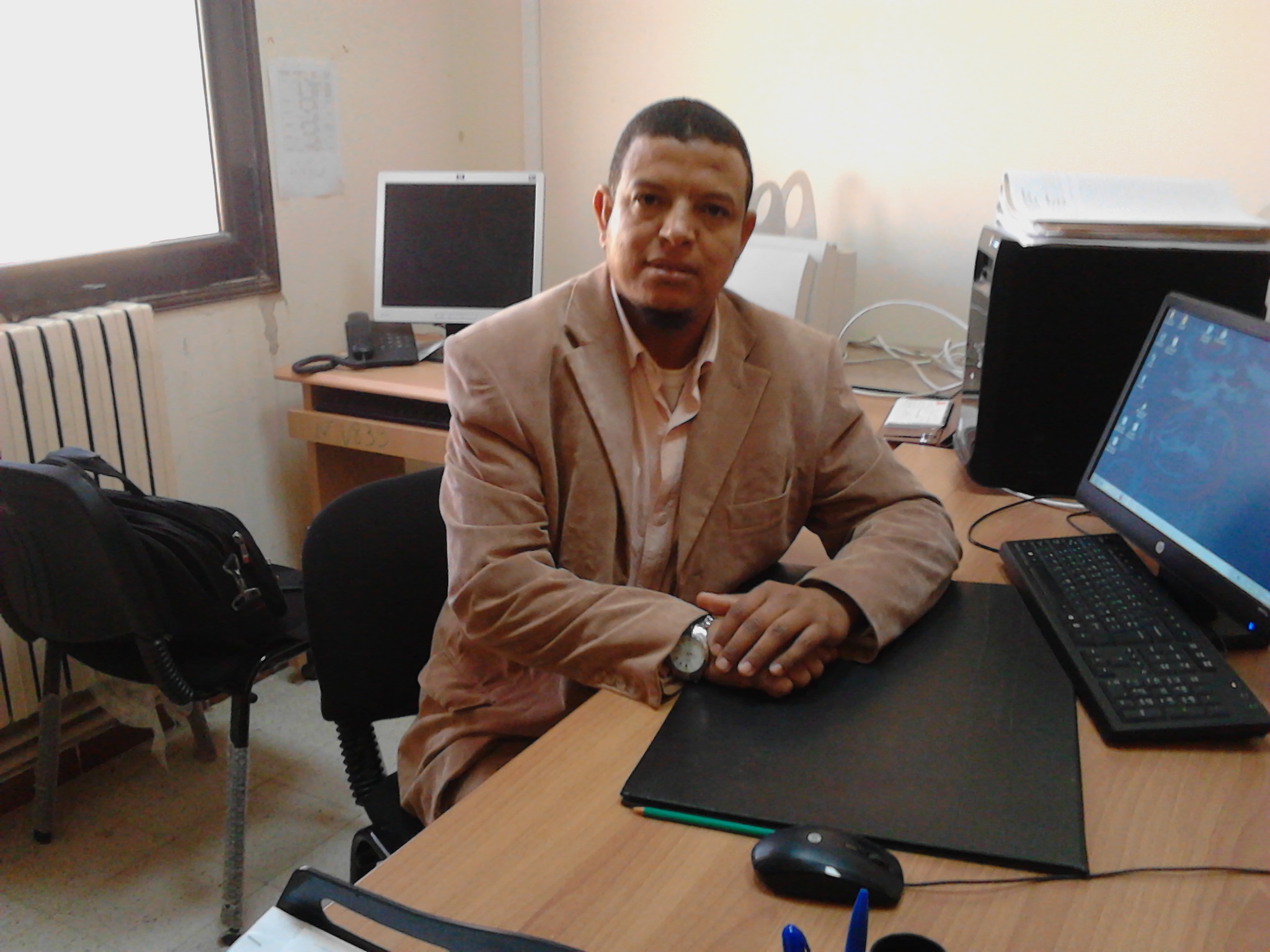
DJAMEL Temim
جمال تميم
djamel.temim@univ-msila.dz
06 64817728
- Department of HYDRAULIC
- Faculty of Technology
- Grade MCB
About Me
Doctorat Science en Hydraulique. in Université Mohamed Khider Biskra
Research Domains
Qualité des eaux.Traitement des eaux. Pollution .Environnement. Qualité des eaux.Traitement des eaux. Pollution .Environnement.Developpement durable
LocationMsila, Msila
Msila, ALGERIA
Code RFIDE- 2023
-
Encaderement master
Mecheri Said , Memou Abdelghani
Mecheri Said + Memou Abdelghani-Etude d’élimination de la pollution résultant à partir des margines par coagulation/floculation (Combinaison de sulfate d’aluminium et polymère organique chemifloc) 2022/2023
- 2023
-
Encaderement master
Djazouli Yahia
Djazouli Yahia Évaluation de la performance d’une station d’épuration des eaux usées urbaine (station d'étude proposé Sidi Aissa.) 2022/2023
- 2022
-
Encaderement master
HAFSI Laid , DJAIDJ Belkacem
HAFSI Laid + DJAIDJ Belkace Traitement Des Eaux Du Barrage Fontaine De Gazelles-Biskra Par Coagulation Floculation 2021/2022
- 2022
-
Encaderement master
Aous Said , Gelmine Ayoub
Aous Said + Gelmine Ayoub Diagnostic et évaluation des performances de la station d’épuration des eaux usées de Bou-Saadâ (Wilaya de M’Sila) 2021/2022
- 2021
-
Encaderement master
SELIKH yousra , CHENENE hayette
SELIKH yousra CHENENE hayette OH Étude comparative entre les caractéristiques du ressaut hydraulique dans un canal triangulaire en contre pente et son homologue du ressaut hydraulique dans un canal trapézoïdal a pente négative 2020/2021
- 2021
-
Encaderement master
Chennafi bouthina
Chennafi bouthina - Traitement des Eaux de Surface du Barrage El K’sob par Coagulation Floculation 2020/ 2021
- 2021
-
Encaderement master
BAKIR Rafik
BAKIR Rafik - Diagnostic et Evaluation de la Performance de la Station d’Epuration de M’sila
- 2020
-
Encaderement master
Leblalta, Mohamed , Aouina, Badreddine
Leblalta, Mohamed Aouina, Badreddine Élimination des pesticides par coagulation - floculation 2019 2020
- 2020
-
Encaderement master
Habeta nour el houda , Naili hadjer
Habeta nour el houda - Naili hadjer - Etude comparative des propriétés physicochimiques des effluent d'huile d'olive (margine) par différentes procèdes 2019 /2020
- 2016
-
Encaderement master
Mahamdi Alaeddine
Mahamdi Alaeddine Conception d’un réseau d’assainissement avec l’utilisation du Système Information Géographique (SIG) pour la présentation « Village d’Ouled Bia » Commune d’ouled Addi Guebala (W. M’sila) 2016
- 2015
-
Encaderement master
Amroune, Hicham
Amroune, Hicham - Dimensionnement du réseau d'assainissement du centre de Mezrir commune de M'sila 2015
- 2015
-
Encaderement master
Boughrara asma
BOUGHRARA Asma - Etude du reseau d'assaianissement du centre DRAA BEN REBEH Commune de Msila
- 2014
-
Encaderement master
DEBIHI, Alaeddine
DEBIHI, Alaeddine Etude du réseau 'assainissement du village CED L'KSOB (commune de M'siEnrded u réseaud 'assainissemendtu village CED L'KSOB (communed e m'sita (University of M'sila, 2014) DEBIHI, Alaeddinela
- 17-07-2023
-
Doctorat Science en Hydraulique
Possibilité d’élimination des margines brutes par coagulation -floculation au sulfate d’aluminium et au Chlorure ferrique - 18-06-2008
-
Magister
LE RESSAUT HYDRAULIQUE DANS UN CANAL TRIANGULAIRE EN CONTRE PENTE - 21-06-2005
-
Ingenieur d'etat en Hydraulique - Spécialité Ouvrage Hydrotechniques
Etude comparative du ressaut hydraulique dans un canal rectangulaire et son homologue triangulaire - 1980-04-22 00:00:00
-
DJAMEL Temim birthday
- 2025-02-12
-
2025-02-12
Possibilité de réduction de risque des margines (les eaux d’huileries d’olive) sur l’environnement dans l’abattement de la pollution des cours d’eau
Les margines sont des effluents issus de l'extraction de l'huile d'olive. Elles comprennent l'eau contenue dans les cellules de la drupe, les eaux de lavage et les eaux liées au processus de traitement
Citation
Djamel TEMIM , ABDEREZAK Guemache , saadia.guergazi@univ-biskra.dz, ,(2025-02-12), Possibilité de réduction de risque des margines (les eaux d’huileries d’olive) sur l’environnement dans l’abattement de la pollution des cours d’eau,1er séminaire national sur l'eau, Environnement,Université de Tamanghasset
- 2024-12-16
-
2024-12-16
Possibilité de réduction de risque des margines (les eaux d’huileries d’olive) sur l’environnement dans l’abattement de la pollution des cours d’eau
Possibilité de réduction de risque des margines (les eaux d’huileries d’olive) sur l’environnement dans l’abattement de la pollution des cours d’eau
Citation
Djamel TEMIM , ABDEREZAK Guemache , saadi.guergazi@univ-biskra.dz, ,(2024-12-16), Possibilité de réduction de risque des margines (les eaux d’huileries d’olive) sur l’environnement dans l’abattement de la pollution des cours d’eau,First international seminar on Natural Hazards, Urban Territory Management and Analysis Tools – Advantages of Artificial Intelligence,Mohamed Boudiaf ,University ,M’sila
- 2024-03-01
-
2024-03-01
• Guemache A, Drif M, Kahoul F,Temim D (May 2024) Article: The effect of methylene blue on water hardness and antibacterial activity and the environment.
This research was carried out to compare complexometric titration methods for the determination of water hardness in the presence of two colored indicators. The complexometric titration with EDTA method has evolved from the typical method of determining water hardness rates used in various references in several countries. Our objective is to make a comparison between Methylene Blue (MB) and Eriochrome black T (EBT) used as color indicators to determine the hardness in drinking water as a function of the flow. Several chemical – physic were used to determine the maximum absorbance of the two dyes UV-visible, identification of functional groups by infrared spectroscopy (FT-IR), supported by the effect of concentration conductivity, pH and turbidity and density. Test results to determine water hydrometric title (TH) in the presence of two colored indicators indicated that the equivalent volume values (Veq) are doubled for the BM indicator compared to the EBT indicator however with impressive TH values in two different intervals between 10 < TH< 20 and 30 < TH < 50. This shows that the colored indicator Methylene Blue has important differences. An antibacterial activity is observed on the dye by the disk method on four bacteria in the agar culture medium, from which it can be said that there is sensitivity to antimicrobial agents against methylene blue. Keywords: complexometric, titration, methylene blue, eriochrome black T, FT-IR, UV-visible, hydrometric title, antibacterial activity.
Citation
Djamel TEMIM , , (2024-03-01), • Guemache A, Drif M, Kahoul F,Temim D (May 2024) Article: The effect of methylene blue on water hardness and antibacterial activity and the environment., TEMIM Djamel, Vol:7, Issue:1, pages:1-15, Brazilian Journal of Animal and Environmental Research, Curitiba, v.7, n.2, p. 1-15, 2024
- 2022-06-06
-
2022-06-06
Removal the pollutants of oil mill wastewater by coagulation–flocculation in order to protect the aquatic environment: Sludge characterization
The industrial sector of olive oil production generates large quantities of liquid effluents called oil mill wastewaters (OMW). These acidic OMW are very loaded with organic matter and polyphenols in the form of humic acid, which is released into the natural environment without any prior treatment. This will seriously harm the quality of the water and pose a major ecological problem. Therefore, the objective of our work is to test the performance of the coagulation–flocculation process by aluminium sulphate (AS) in the elimination of certain parameter characteristics of OMW. These are humic acid (HA), chemical oxygen demand (COD) and turbidity. Different parameters were taken into consideration, such as the effect of AS doses, pH and the variation of powdered activated carbon (PAC) used as an aid coagulant. The X-ray diffraction (XRD), Fourier transform infrared (FTIR) and the scanning electron microscopy (SEM) characterized the solid phase of OMW before treatment and the sludge of the optimal dose of the coagulant. After dilution of the OMW to 1/100, our results clearly showed that treatment reduced the polluting load of water by 67.31 and 71.15%, respectively, for HA and COD, and the turbidity is 82.45%. The pH of the optimal treatment is in acidic medium less than or equal to 5. The use of PAC has led to a remarkable improvement in the removal yields, which exceeds 80% for both HA and COD.
Citation
Djamel TEMIM , , (2022-06-06), Removal the pollutants of oil mill wastewater by coagulation–flocculation in order to protect the aquatic environment: Sludge characterization, Chemical Papers, Vol:76, Issue:, pages:6891–6902, Marek Baráth, Slovak Academy of Sciences, Bratislava, Slovakia